
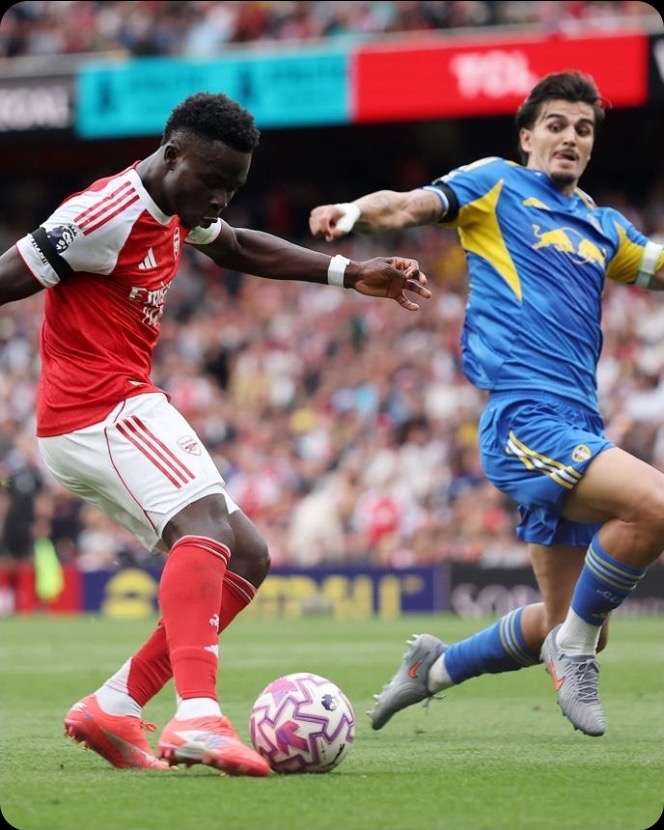
Arsenal showed their resilience to overcome Leeds United in a thrilling Premier League encounter, turning a second-half deficit into a crucial victory at the Emirates Stadium.
Arsenal returned to Premier League action with a statement of intent, fighting back from behind to defeat Leeds United 2–1 in a competitive afternoon in North London.
After suffering a disappointing 3–0 defeat to Brighton before the international break, Mikel Arteta’s side needed a response. Against a Leeds team that had started the season unbeaten, the Gunners were forced to dig deep before finding the quality to turn the game around.
And when Arsenal needed inspiration, Bruno Guimarães delivered.
Leeds Strike First as Arsenal Face an Unexpected Test
The opening stages were competitive, with Arsenal looking to establish control through possession while Leeds remained organised and dangerous on the counterattack.
Despite Arsenal’s attempts to dictate the tempo, Leeds showed they were not at the Emirates simply to defend. Their willingness to press, compete for second balls, and attack the spaces behind Arsenal’s defence created problems for the home side.
Arsenal goalkeeper David Raya was called into action during the first half, making an important save to deny Gabriel Gudmundsson from close range.
At the other end, Kai Havertz came close with a header from Noni Madueke’s delivery, but Arsenal could not find the breakthrough before the interval.
Leeds’ discipline was keeping them in the contest, and the visitors returned for the second half with renewed confidence.
That confidence soon paid off.
In the 55th minute, James Justin found the net following a well-placed cross from Gudmundsson, giving Leeds a deserved lead and putting Arsenal under immediate pressure.
For Arteta, the challenge was clear: find a response before Leeds could settle into a defensive rhythm.
Calafiori Restores Parity
Arsenal did not have to wait long to get back into the game.
Seven minutes after Leeds took the lead, Riccardo Calafiori scored the equaliser in the 62nd minute, capitalising on a move involving Ben White to bring the Gunners level.
The goal changed the atmosphere inside the Emirates.
Arsenal suddenly gained momentum, while Leeds had to reconsider their approach. The visitors had worked hard to take the lead, but their advantage disappeared before they could fully consolidate it.
Calafiori’s contribution was particularly important because Arsenal needed more than possession. They needed a player capable of turning territorial pressure into a decisive moment.
His goal provided exactly that.
However, the equaliser was only the beginning of Arsenal’s response.
Bruno Guimarães Changes the Game
Arteta’s substitutions proved decisive.
The Arsenal manager introduced Bruno Guimarães, Viktor Gyökeres and Jurrien Timber as he looked to inject fresh energy and greater attacking threat into his team.
Guimarães wasted little time making his presence felt.
In the 70th minute, the Brazilian midfielder finished a move set up by Declan Rice, firing a low effort into the net to complete Arsenal’s comeback.
Within 15 minutes of conceding, Arsenal had transformed a potentially frustrating afternoon into a match they were now controlling on the scoreboard.
Guimarães’ goal highlighted the importance of squad depth in a demanding Premier League season. When the starting approach was not producing the desired result, Arsenal had players on the bench capable of changing the game’s direction.
For Leeds, the turnaround was painful. They had competed well, defended with discipline and taken the lead, only to lose their advantage through two moments of quality from the hosts.
Arsenal still had work to do, but the pressure had shifted firmly onto the visitors.
Arsenal’s Tactical Response Makes the Difference
The defining feature of Arsenal’s victory was not simply their ability to score twice. It was their response to adversity.
Before the equaliser, Leeds had made life difficult by limiting Arsenal’s opportunities and threatening when spaces opened up. The Gunners struggled to turn their possession into clear-cut chances.
Arteta’s changes added fresh attacking options and helped Arsenal approach the closing stages with greater urgency.
The combination of Rice’s involvement and Guimarães’ finishing demonstrated the value of midfield quality in tight matches. Calafiori’s equaliser also underlined how defenders can influence games beyond their primary responsibilities.
Nevertheless, Arsenal will know there are lessons to take from the performance.
Conceding first at home exposed weaknesses that stronger opponents could exploit. Against Leeds, the Gunners recovered in time. In other matches, they may not enjoy the same margin for error.
For a team with ambitions of defending the Premier League title, the ability to win difficult games is essential. So, too, is the ability to avoid making those games unnecessarily difficult.
What the Result Means for Arsenal
The victory provides Arsenal with an important response following their defeat to Brighton.
Beyond the three points, the comeback offers evidence of the team’s resilience and the value of having impactful alternatives on the bench.
The performances of Calafiori and Guimarães will also encourage Arteta. Both players contributed at crucial moments, demonstrating that Arsenal’s attacking threat does not have to depend on one individual.
However, the bigger challenge remains consistency.
A title defence is rarely determined by one spectacular performance. It is built through the accumulation of points, particularly on afternoons when a team must work harder than expected to secure victory.
Arsenal have shown they can recover from a setback within a match. Their next task is to maintain that response across the wider season.
What Leeds Can Take From the Defeat
For Leeds United, the result will be disappointing, but the performance offers reasons for encouragement.
Daniel Farke’s side demonstrated that they could trouble one of the Premier League’s strongest teams, even away from home. Their defensive organisation and willingness to attack prevented Arsenal from enjoying a straightforward afternoon.
James Justin’s goal rewarded their persistence, while Gudmundsson’s contribution highlighted the threat Leeds could create from wide areas.
The frustration will come from losing control of the contest after taking the lead.
Conceding twice in quick succession against a team of Arsenal’s quality is costly. Leeds will need to manage those moments better if they want to turn competitive performances into consistent results.
Still, there is a difference between being outclassed and being narrowly beaten after leading. Leeds experienced the latter, and their overall approach suggests they have the tools to remain competitive.
Their challenge now is to learn from the defeat without allowing it to undermine the confidence built during their unbeaten start.
Final Verdict: Arsenal Find a Way
Arsenal’s 2–1 victory over Leeds United was a reminder that Premier League matches are often decided by small margins.
Leeds had the lead and the opportunity to frustrate their hosts. Arsenal, however, responded through Calafiori’s equaliser and Guimarães’ decisive finish, turning the contest around with two important moments of quality.
For Arteta, the result offers relief, three valuable points and a timely reminder of his squad’s depth.
For Farke, it is a painful defeat, but one that should not erase the positives from Leeds’ performance.
Ultimately, Arsenal demonstrated a quality every title-chasing side needs: the ability to find a way to win even when the match refuses to follow the expected script.
Final score: Arsenal 2–1 Leeds United
Goals: James Justin (55′) — Riccardo Calafiori (62′), Bruno Guimarães (70′).
The takeaway: Arsenal’s comeback was powered by decisive contributions from their squad, while Leeds will rue their inability to protect a hard-earned lead.